
I got a great question from a dear friend (a series of great questions actually) that I’ll answer in a series of posts. One of her questions was what we do to help kids catch up developmentally.
The short answer? Believe it or not, just play with them. A lot.
All our Littles have been evaluated by Early Intervention at some point during their stay with us. Early Intervention is an state-wide organization (run through the Department of Heath I believe) that helps assess the development of babies and toddlers and determines what additional services they may need to thrive. It’s meant to catch developmental delays before kids become school-age. It applies for kids under age 3 (the school districts provide EI services after age 3), and all that has to be done is we have to request that Early Intervention evaluate a child. They bring in a bunch of specialists who help assess kids’ gross and fine motor skills, their sensory issues (sensory seeking or sensory avoidant), their language (both receptive and expressive), and other skills. At the end of the evaluation they sometimes make recommendations for additional evaluation or for services that the child should receive. Those services include PT, OT, speech therapy, and special education teachers.
I’ve learned a LOT from all our kids’ service providers. I’ve sat down with each of them and asked for instructions from them for what we should be doing with the kids between appointments. From PT I’ve learned that active play by kids is hugely important. Speech therapists have taught me that just talking to kids is essential. And Special Ed teachers have taught me that getting down on the ground and playing with kids with toys is crucial.
Literally. It can be that easy to help kids catch up.
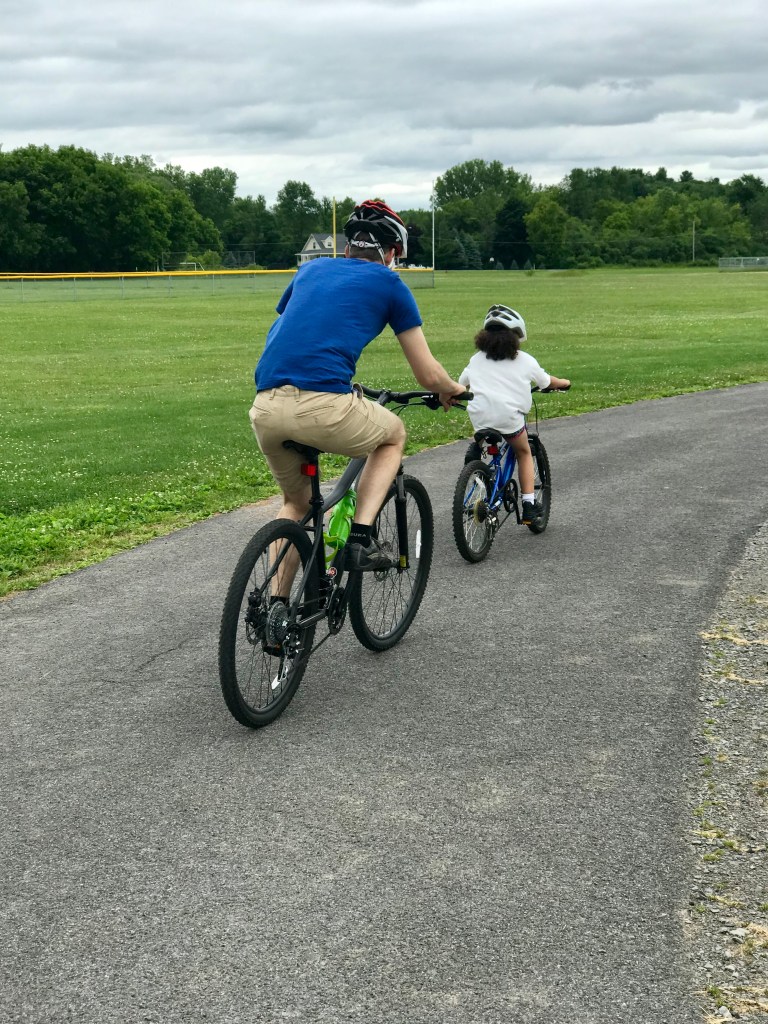
So we do things for gross motor skills like take kids to playgrounds that are age-appropriate (there’s one right behind our house about 2 blocks away so we are super lucky). We romp with kids in the yard. We let them climb the furniture. We make silly games out of walking on pillows. We take them swimming. We encourage them to run on uneven ground. And when they’re old enough to fit on one, we provide bicycles and lessons on riding and balance.
With regard to speech and language, we talk to kids allllllll the time. When Kiddo came to us, not only was her vocabulary extremely limited, she didn’t understand the typical back and forth of a conversation. So, quite simply, we modeled that for her. We would talk with each other in front of her, and include her in conversation. She struggled at first but got the hang of the give and take of human conversation within a few months. We avoid baby talk and use our usual vocabularies with kids and they catch on to the meaning remarkably well.
We teach kids words and colors and numbers and letters through alphabet puzzles and drawing on paper with markers. We have lots of Little People animals and use them to help teach kids what sounds animals make. I ask kids what letters are on things in the doctor’s office and grocery store, or what colors things are, as a way to pass the time and keep them from climbing the walls with boredom.
Kids’ brains are naturally so curious, and they love interaction with grownups. Most of our kids come to us starved for attention. So when we give undivided attention to them they really engage and their little brains can almost be heard whirring and clicking as they learn.
We read books with kids. There are bedtime stories and sessions in the middle of the day where kids bring us books and we read them. We’ve sought out all the books we can find that are engaging for kids and don’t make our brains melt with repetition. Kids love the snuggle time during reading, and the power of getting to choose the book. They don’t have to be alphabet teaching books or anything like that – almost any picture book will do. Sometimes when kids come to us they can sit through exactly one page of reading at a time before they’re off getting the next book, but that counts too. It just tries my patience, but they learn gradually to sit through more and more of the books.
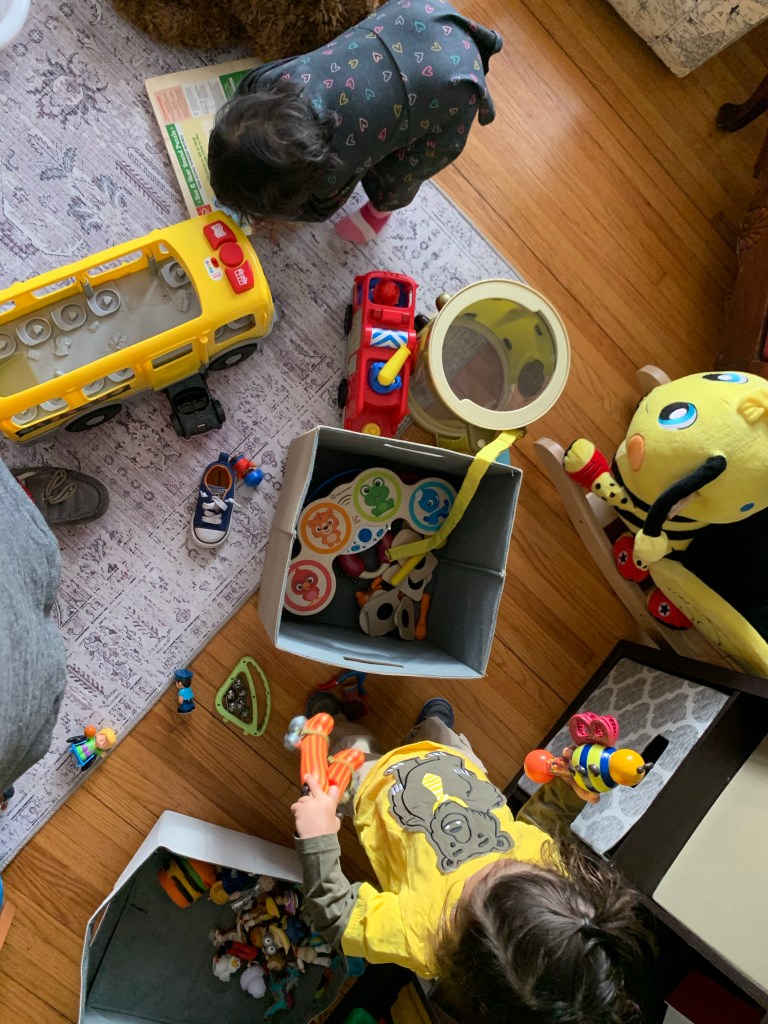
And we spend time with them being silly with toys. This is one of my favorite videos ever because Mouse is so damn cute and Seth is so silly with kids. I love it. But this video models exactly what I’m talking about: playing with toys in a child-led way. This is the silly play that causes kids’ brains to expand and light bulbs to go on.
There isn’t any magic to getting kids caught up, but honestly the process does seem sort of magical.
To be clear, we are not superheroes who give our kids our non-stop undivided attention all day every day. That’s not needed. We do things like other normal parents, like spending too much time on our phones. We occasionally turn on a movie and let Tiny watch it as a way of babysitting her. (She always asks for Frozen I or II. What is it with those movies?! I like them but kids LOVE them. She sings along to “Let it Go” with abandon.) There are times when I say no to reading a book or getting down on the floor to play because I’m just plain too tired or distracted or bored with the prospect. And that’s ok too because kids need to learn to entertain themselves sometimes.
But our kids DO get a lot of attention and play overall. And apparently that is what is needed because we watch miracles happen with our kids as they catch up with what they’ve missed out on because of the stress in their lives before coming to us. Time and safety alone are huge healers.
Sometimes our kids need more help with behaviors than we can manage ourselves, and we’ve discovered an agency that provides play therapy and skill builders to kids in foster care (or who have ever been in foster care). It’s all paid through Medicaid and we just had to learn that they exist in order to utilize their services. We’ll now use that particular agency for all our kids if possible. I’ve already put in a plug for therapy for grown ups, but let me here put in a plug for therapy for kids, too. Play therapy is amazing. And it really can help kids work through their traumas.
So that’s our “magic.” Service providers, and playing with and talking to and reading to kids. We provide the framework and the kids themselves do the rest.
 sprinklesonachaoscupcake.com