
We already talked about ADHD, now why is there a blog post about autism in a blog about foster care? Still partly because it’s my blog, and my story, and I feel like sharing. Boom. It’s also because there are plenty of neurodivergent kids in foster care too, so this might help a foster parent understand a kid they’re caring for a little bit better. Or maybe it will help someone understand themself better. Hmmm.
Also batten down the hatches, pop some popcorn, and get a cup of coffee. This is a long post!
Frankly I’m scared to write about this topic. But I’m a stubborn pain in the a$$, and when I’m afraid of things I tend to try to tackle them head on. Unless it’s making a phone call. Texting? Fine. Actually picking up the phone and calling someone? Seventh level of hell stuff.
I want to preface this tale with a little basic info about autism. There are different levels of it:
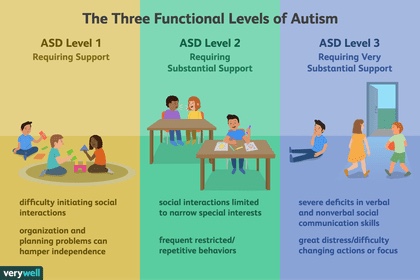
The DSM-5-TR has a new definition of autism and it requires deficits in three categories of social communication and interaction, and restricted, repetitive patterns of behavior in two of four categories. You can find the full DSM-5-TR definition Here.
Sensory Issues
I have long known that I have significant sensory aversions. Certain sounds – like our Milwaukee portable vacuum and my husband’s radar detector – make me absolutely crazy. Overstimulation makes me crazy. The feeling of cotton sheets touching the dry skin on my hands and feet makes me crazy. The slipperiness of counter cleaning with spray cleaner and paper towels makes me twitch. And so on.
But I just thought I had a sensory processing disorder and 🤷🏼♀️ that was that.
👀 Contact
I’ve also long known that I have a problem with eye contact. Namely that I hate it. When I’m having a conversation with someone, nearly half of my brain space is occupied by trying to navigate the appropriate amount of eye contact to make in order to make it seem like I’m paying attention, but not make that person feel uncomfortable, and not push the limits of my own discomfort too far. I’m constantly calculating when to look away, and when to look back at the person. Can I look between their eyes and not have it be obvious? Which eye am I supposed to be looking at anyway?
The other half of my brain space when I’m in a conversation is planning carefully what should come next. When is it going to be my turn to speak? And what am I going to say to make it sound like I’m engaged and interested, but keep them talking so I don’t have to? I get so wrapped up in my thinking about how to make the conversation seem “normal” that I often miss what the other person is saying. I’m incredibly bad at this when making small talk with neurotypical strangers.
Just a few months ago I started talking with Seth about my eye contact and conversation conundrums, and he was incredulous. How can anyone’s brain be working that hard to make small talk? “You don’t just… you know… converse?” Nope. No I don’t. I strain and struggle and hate every minute. Small talk is evil. I want to talk about something meaningful and real! And not with a stranger!
The conversation with Seth was eye opening. I started researching on autism. I bought some books on adults with Level 1 Autism Spectrum Disorder. And I started watching “neurospicy” TikTok to get some info about people’s first-hand experiences living with autism as adults. It felt like… well. Like I found my people. I related So Darn Hard.
Friendships
Mulling things over, I asked my sister if she thought I could be autistic and she answered that it always seemed like I had friends, so she didn’t think so. Weeeeell, first that isn’t exactly an autism test. But second, my friendships growing up were sporadic, and either quirky or troubled, and I think showcase how autism affected me as a kid.
To the extent I was “friends” with any kids on the fringe of popularity in elementary and middle school, they were frenemies who were horrifically mean and bullying, but I stuck around because I wanted their attention because I wanted friends.
To the extent I was friends with other kids during that time, they were the quirky kids, or other outcasts. Some of those friendships were genuine and I treasure two of them to this day. But honestly? Most of those kids were probably neurodivergent too, whether they know it or not yet.
There was so much bullying. I have a traumatic memory of being chased across the playground field by every single girl in my class, threatening to beat me up. I was terrified and running for my life and it stung most because the two girls in the class who were most emotionally challenged/badly dressed/socially awkward were part of the gang. I’d always thought they, at least, were not superior because they were mocked as much as I was. But no – I was officially low girl on the grade school totem pole.
I spent my entire grade school and middle school years feeling like a terrible outsider. I was lonely, isolated, and felt like I didn’t fit in anywhere. I was depressed. I felt like an outsider in my family too, not just at school. I grew so shy that I would blush furiously anytime anyone would talk to me and expect a response.
As I reached high school I finally hit my stride with friends. I switched to a private school where being a nerd was acceptable, and quickly developed a close group of delightfully weird and loving friends, including a bestie I still adore to this day, and whose parents saw so much of me they unofficially adopted me and still call me their “other daughter.” But my friends were largely guys, and somewhat idiosyncratic ones at that. Studies have shown that autistic girls often function as well as allistic (non-autistic) boys, and I found that very true. The guys expected less of me social-formality wise and I could relax with them.
And my bestie? She’d been bullied a bunch growing up too, and wore a crescent moon drawn on her forehead in blue eyeliner to represent her Pagan beliefs. She’s not neurodivergent, but she was not exactly un-quirky, and was so open minded that she welcomed me and my own brand of eccentricities with open arms. We were inseparable.
College was the same pattern all over again. The “popular” conventional kids shunned me and my queerness, my haircut, my fashion, and my lack of social cue catching. I had two popular roomies my first year and it was hellacious. I found some peeps, though. Deliciously wonderfully awesomely quirky, genuine people, three of whom keep me going on a day-to-day basis still. Why did it work with those three and why does it still work with them today? Because they’re The Real Deal. They are truly open minded, and take my weirdness in stride. We laugh together about my quirks and theirs. I got so lucky.
Masking
Why did my friendship skills progress over time? Because I progressed in masking skills.
What the hell is masking? I can’t explain it better than this:
Masking, which is also called compensating, is a social survival strategy. How it looks will vary from person to person, but masking can include behaviors like these:
- forcing or faking eye contact during conversations
- imitating smiles and other facial expressions
- mimicking gestures
- hiding or minimizing personal interests
- developing a repertoire of rehearsed responses to questions
- scripting conversations
- pushing through intense sensory discomfort including loud noises
- disguising stimming behaviors (hiding a jiggling foot or trading a preferred movement for one that’s less obvious)
Stolen from Healthline.com Here. 
I do all of those except mimicking gestures. And you know what’s exhausting and a hell of a lot of hard work? Masking. It costs autistic people in so many ways and can lead to autistic burnout. It prevents us from being seen as we really are, prevents people from learning about autism, prevents us from going through life in a genuine way. But it’s critical.
My greatest masking was at the law firm. Holy Hannah did I have to work hard at masking there! There was ONE attorney out of like 65 who was comfortable with me as myself and the rest I put on a show for. Yet despite my best, most exhaustive efforts, I was always on the outside. I never was part of the “in” crowd. I wasn’t well liked by management. I wasn’t advanced by management for a variety of reasons but I’m certain my social skills were part of it. I tried so dang hard but no one there shared my quirky obsessive interests, and people would take offense to statements I’d make and I’d be so confused as to what I’d said wrong. I made friends with staff members who were genuine and likable people and that was a social faux pas too. As a social experiment, life at the law firm was a debacle.
15 years there led to my being depressed, discouraged, exhausted, and burned out. Leaving was the biggest relief I’ve ever experienced in my life.
Diagnosis
I want to be VERY clear about this: diagnosis with autism or ADHD as an adult is a PRIVILEGE. It costs a fortune and is hard to come by. There aren’t enough specialists who work with kids, let alone adults. And there are even fewer specialists who are not focused on the tests that have been developed over the years for white boys. Self diagnosis with autism based on research and online tests is VALID.
That said, I wanted the real deal. Not that we could really afford it because it costs a goddamn fortune, but we prioritized getting me a proper medical assessment by a true specialist because I felt like I needed a specialist to listen to everything and test me and analyze me. I know I will get pushback from a lot of folks. I wanted a nice thick written report spelling it all out so I would not doubt myself when challenged.
I got my initial result last Tuesday: solidly level 1 autistic. She has no questions or doubts about it. I’m still waiting for the written report and will be fascinated to read it.
Congrats, you’re autistic!
It’s funny, the woman who did my assessment congratulated me with a grin when she told me my initial results. When I first told my therapist – who knows me best in this world second only to Seth – that I suspected I might be autistic, she grinned at me too with this knowing look she gets when I’ve finally figured out something for myself that she’s suspected for ages. She too congratulated me.
And the funny thing is? It feels GREAT. So many mysteries have been explained. Why I had such trouble with social skills and friendships growing up. Why the law firm sucked the life out of me. Why I hate small talk. Why I stim and why I have to have noise cancelling ear muffs. I’m loving understanding myself better and just starting to untangle how autism has shaped every aspect of my life
 sprinklesonachaoscupcake.com